Visit our farm's Web Site at: www.WishfulAcresFarm.com !
Showing posts with label local foods. Show all posts

Wednesday, May 16, 2012

This week's lettuce harvest - beautiful leaves of light & dark green plus red.

Visit our farm store this weekend to buy some! Fridays 10-7, Saturdays 10-4, Sundays 10-4.

www.wishfulacresfarm.com

Wednesday, May 9, 2012

Spinach harvest at Wishful Acres!

harvesting & washing winter spinach. so sweet!

Lettuce heads & escarole

Gorgeous lettuce & escarole heads! First harvest for CSA begins today!

Tuesday, February 28, 2012

Delicious spring greens are growing here at the farm!

We're already up & growing here at the farm.The season is coming! In just 2 months, the spring CSA begins!

Can't you almost taste these spring greens? We're growing the best tasting food in the world, right here at Wishful Acres Farm. Won't you join us in enjoying the feast?

Visit our web site at www.WishfulAcresFarm.com and click on CSA (Community Supported Agriculture) for details.

Sunday, June 19, 2011

Fathers Day French Toast - all local ingredients yum!

Fathers Day French toast - the 7 grain whole wheat bread came from Kristi's Kitchen (my friend who sells at our Freeport Farmers Market), the maple syrup came from some friends who farm & do maple syrup a few miles away, the berries from a farm down the road, the eggs from our hens, and the raw milk from a nearby farm!
All agreed it was the Best French Toast Ever! Fresh makes it better, support local farms & you will have the best food you can imagine!
.

Sunday, July 18, 2010

Local foods in season - a whole meal

.
My favorite time of year is here!  Ripe tomatoes & sweet corn are coming into season!!

Last night, my husband and I sat down to a great meal with our sons.  Halfway through the meal, I realized that every item on our plates was grown within 15 miles of our home.

We had grass-fed beef, sweet corn, tomatoes, green beans, and roasted eggplant.  The green beans came from our farm plot garden, and everything else came from local farmers.  My own tomatoes & eggplant aren't ripe yet, but there is one nearby farmer whose are and I was more than happy to support her at Saturday's market.

I don't grow sweet corn, it just takes up too much land and is already so abundant here, so I always buy from local farmers to eat fresh and freeze for winter. Let me tell you, if you live near me here in Northern Illinois and buy your fresh sweet corn in the store... stop!  It's really so much better when it's very fresh.  Local farmers who sell their sweet corn pick it daily to sell.  Try an ear of just-picked sweet corn, then compare it to that weeks-old ear you got from the store.  If you still think it was worth saving 2 nickels by buying it at the store, then you can call me crazy.

As for the tomatoes, I purchased 2 pounds from the only grower who has any yet, brought them home, and... between myself, my mother, and my 4 year-old son, they were gone within a few hours.  Delicious.  I had my first peach tomato - I've seen them in seed catalogs, and let me tell you that after tasting one they might be on my growing list for next year. 

It was a great meal, best meal I've had in a long time. 

I also began putting up our garden-grown green beans today.  I prefer to blanch & freeze mine, it's much easier than canning.

Hope you're all enjoying the fruits of summer!!!

Friday, November 27, 2009

Community foods all in hand!

As my husband said today, "We're just trying to eat a traditional Thanksgiving meal in the spirit of the Pilgrims.  The Pilgrims didn't run to the grocery store for their ingredients. They used what was grown & raised within their community."

And in the spirit of the Pilgrims, we now officially have all of our community-produced ingredients in hand!  Today we acquired the last items:  the milk from a community organic dairy farm...


The radishes, greens, lettuce, kohlrabi, and carrots from our garden...


And our spices.  This was our one "cheat" item.  Spices like cinnamon & nutmeg aren't grown anywhere nearby.  But, we did do our best and bought them from a local distributor, Furst McNess Company....


My husband is busy brining our locally-raised, free-range, heritage turkey.  He uses an Altan Brown recipe.  It's so good.  Can't wait until tomorrow!


Sunday, November 22, 2009

A big container of Duh!

Duh!  That's what I said to myself last night.

I was explaining to my mom why she couldn't bring cranberries (or the gelatinous goo in the can)  to our Thanksgiving feast.  She was actually really excited when I told her about our area-only local foods meal.

When I told her I'd have to make butter to use in the pie crust, she eyed me over a few times and asked "Why would you use butter in a pie crust?"  "Well, I explained, already growing frustrated....  Well, it has to be local and I'm not going to use Crisco".  "Of course not", said the woman who grew up on area farms as a child.  "You go to the local meat shop, where you get your local meat, and buy lard there".  DUH!  I had seriously underestimated my mom.

Of course, I couldn't go to my normal meat shop because it's in Lena, which is about 10 miles away.  But don't despair, we live in the greatest agricultural region in this country.  There is another local meat butcher/supplier within our Freeport-area community. 

I called, and the next day I had in my hands a beautiful white container of.....


lard.

4 pounds of the stuff, locally produced, from locally raised animals.

Just like our grandparents would have made a pie.... and some would argue it's still the best way to make a pie crust.

Hey, my heart can take the lard for one day!  How often do we eat pie, anyway?  It's a special treat.

(Speaking of which, wouldn't it be considered "all-natural"?  Hmmmm?)   :-)

My quest continues.....

Thursday, November 19, 2009

Our really local foods challenge: Thanksgiving!

Some may say we're crazy.  Most would wonder why we would bother.

I've issued a challenge to my husband:  we're going to cook our entire Thanksgiving meal with local foods.  Really local.  I think we may be able to do it without leaving our community!  Within one school district.  No farther than 5 miles or so.  

All of it.     Really!

The turkey, the stuffing, mashed potatoes, pickles, corn, pumpkin pie, bread, butter, beans, salad, on and on.

I'm already working out the details in my head.  We'll have to make our own butter with local raw milk.  I've done that before.  Make our own mayo (deviled eggs) with local eggs.  Believe it or not, I've even done that before.  Though I'm not sure how I'll replace the oil in the mayo...

As for the stuffing & breads, I found a source of  locally-grown wheat and a friend to grind it for me.  We grew hundreds of onions this summer, those will be great in the stuffing.  I don't have any celery. I do know someone who grew it, but I'm not sure if they kept any in their fridge after harvest.  I'm thinking I could just substitute the celery with greens I still have growing in the garden (kale, Holland greens, spinach).

The mashed potatoes will be easy, we have boxes full of potatoes that we grew this summer.

The corn & green beans are in our freezer now.  The sweet corn came from a farm within 5 miles, the green beans from our own garden.

Salad?  Check.  Still have fresh lettuce, spinach, and radishes coming in from my garden.

Sweet potatoes?  Well, I didn't grow any this year, but I do know local people who did.  If they still have some for sale I can buy from them.  Or.... I can substitute with mashed winter squash.  I grew lots of that this summer.

Veggie tray?  Check.  Radish, rutabaga, carrots coming from garden and I still have some fresh pattypan zucchini.

Dessert? Check!  We baked & froze pumpkin.  I still have fresh pumpkin, too.  With the locally grown & ground wheat for the crust, this should be pretty easy.  I could also make an apple pie with the apple pie filling I canned this summer (apples from a local farm).  Or a rhubarb custard pie with the rhubarb from my fridge, and local eggs.

Most important: The turkey.  There is a farm just a couple miles from us that raises free-range turkeys. Done!

Problems:  There will be some things we'll have to cheat on.  Herbs & spices, salt, and sugar.  I'll use local honey wherever possible, but if I decide to make a custard pie I'm not sure that honey would work there...

Just some thoughts.  Oh, and I just realized almost all this food will be organic!  (I'm not sure about the wheat)...

I'll keep you posted!

p.s. Don't tell my parents or brother.  They're coming over for this meal.  They're not very into the local foods, organic, healthy, tasteful, good-for-you thing.  At all..... they're more the "eat out every meal, fast food types".  Shhhhhhhhh......

Friday, November 13, 2009

Eating local, grass-fed beef

Every fall, we order a quarter cow.  Yes, that's what we call it around here.  The meat from 1/4 of a cow to fill our freezer and feed us for a year.

I'm fortunate enough to live in a part of the country with plenty of small farmers who still raise their happy cows on pasture.  And fortunate enough to have a wonderful butcher shop nearby.

I grew up eating the meat from this particular butcher shop. It's the best meat you'll ever taste. 


Usually, each fall we order our quarter of beef from the shop.  We just take whatever local farmer's meat they happen to have on hand.

However, this fall we were lucky to discover that one of our close friends' parents raise pastured cows.

We went in with others and were able to get a whole cow processed (each taking a quarter).


Another bonus for those who buy meat this way - the meat is processed at the same price for the entire quarter.  So, let's say you pay $3 per pound for all the meat.  That means you are paying $3 per pound for not only the ground beef, but also for the t-bone steaks, the porterhouse steaks, fajita meat, roasts, etc.  It's a win-win situation!


To us, this is normal.  It's how we get good meat.  Each time I taste meat from the grocery store, I cringe.  It tastes..... horribleDisgusting. It brings images of factory farms and unhappy animals.   Nothing like the meat we get from our local shop.  I laughed when, a few months ago, TIME magazine ran an article talking about this "new" way to buy local meat.  They spoke of people going together to buy a cow from a local farmer to be shared amongst them.  Guess I was surprised because I assumed this was not something unique.  Guess I was wrong again.

We're definitely blessed, living somewhere where we can enjoy the freshest, best-quality local meats. 

Friday, June 12, 2009

Cheeseheads

Since we're not Wisconsin residents I guess we're not "official" cheeseheads. (Those from afar may not know that the state of Wisconsin produces the most cheese in the U.S.)

However, living all my life 15 miles from the Wisconsin border has definitely had an effect on me.
I adore cheese. It's one of those foods that I couldn't give up. I'd give up sugar and sweets before I would ever give up cheese. Truly.

There are 3 or 4 cheese factories within a 10 mile radius of my home. Yes, I am lucky. We have lots of opportunities to purchase local cheese.

There is a great town just over the border that has several stores which offer such cheeses. Oh, the varieties are vast. The smells are overwhelming. It's.... wonderful.

One such store has a bargain bin! They sell all their scratch & dent (for cheese this would be the end pieces with some rind on them) for $1.99 per pound. Sometimes the bargain bin is empty.

However, a few months ago we hit the motherload. The bargain bin was overflowing. We bought award-winning 2-year aged cheddar, jalapeno cheeses, smoked brick, smoked cheddar, dill cheddar, garlic curds, baby Swiss, aged Swiss, Romano, Parmesan, bleu, feta, Colby, Colby Swiss, and more. Yes, all for $1.99 per pound! Some of these cheeses normally cost $10 or more per pound.

We bought so much we had to bring it home in a huge box. And it wouldn't fit in our refrigerator...
What to do with all this cheese?


Luckily, I have a loving husband (who also likes cheese but I have yet to convert him to the "stinkier" varieties, lol. He's from the city.). He agreed to convert his beer fridge into a cheese fridge.

A few months later, and we still have the fridge almost half full of cheese! You should have seen the fridge when we first got home - it was so full we could barely close it. Mmmmm.....cheese.
For an easy, delicious cheese recipe check out my easy Alfredo sauce. It's made with cream cheese, parmesan cheese, butter, and milk.

I've made my own cheese. Check out New England Cheesemaking Supply Company for supplies. You'll need milk that is not ultra-pasteurized. It's supposed to state such on the gallon, so I originally bought some milk that simply stated "pasteurized". Well, no luck. The next time I tried, I used organic raw milk from a nearby farm. Success! I made mozzarella. I think when my kids are a tad older I'll get more into the cheesemaking.

Thursday, June 4, 2009

Are you a locavore?

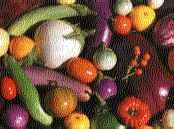
Beautiful heirloom vegetables:
Locavore is a new term, defined below courtesy of Wikipedia:

Local food (also regional food or food patriotism) or the local food movement is a "collaborative effort to build more locally based, self-reliant food economies - one in which sustainable food production, processing, distribution, and consumption is integrated to enhance the economic, environmental and social health of a particular place" and is considered to be a part of the broader sustainability movement. It is part of the concept of local purchasing and local economies, a preference to buy locally produced goods and services. Those who prefer to eat locally grown/produced food sometimes call themselves "localvores" or locavores.

100 years ago, everyone was a locavore. Our great-grandparents would have laughed at our desire to eat lettuce in January.

There are so many reasons to eat locally. Here are just a few, courtesy of http://www.eatlocalchallenge.com/:

1. Eating local means more for the local economy.
2. Locally grown produce is fresher.
3. Local food just plain tastes better.
4.Locally grown fruits and vegetables have longer to ripen.
5. Eating local is better for air quality and pollution than eating organic. (This one bothers me a bit because it's very possible to eat local organics.)
6.
Buying local food keeps us in touch with the seasons.
7. Buying locally grown food is fodder for a wonderful story.
8. Eating local protects us from bio-terrorism.
9. Local food translates to more variety.
10. Supporting local providers supports responsible land development.

For greater explanations of these 10 reasons, please visit http://www.lifebeginsat30.com/elc/2006/04/10_reasons_to_e.html.

On a more personal note, I'll give you my reasons for eating local foods whenever possible. It makes no sense to me to buy carrots, grown in California, from a grocery store when there is a struggling local farmer who will sell me fresher, tastier, more exotic carrots for the same price.

Having lived my whole life in the rural midwest, and seen our economy slide downhill, I can tell you firsthand how important it is to keep our money in the community. There is the study that shows for every $1 you spend locally it generates twice as much for the local economy. For example, I give $1 to a local farmer who then spends his/her money on items in our local stores, property taxes, other farmers, etc. When businesses are not owned locally, money leaves the community at every transaction.

My two oldest boys and I shelling locally-grown peas, 2008.

I was raised eating locally. This was definitely unusual for the 1980s, but my farm-raised mom would always buy fresh foods from farmers. We also have distant cousins around who farm and we would support them whenever possible as well. Our community has always had a farmers market. My mom would put up food each summer. This usually included sweet corn (which she cut off the cob and froze) as well as canning tomatoes. Some years also green beans, rhubarb, applesauce. There is no substitute for local tomatoes. The tomatoes in the grocery store should be left there. Seriously. They're poor substitutes for the real thing. They were picked before they were ripe, shipped thousands of miles. Plus the variety sold in grocery stores was chosen for it's thick skin (helps when shipping them, doncha know). Yuk. Grow your own. If you don't know how to can, toss them whole into freezer bags and freeze them for winter. Or support your local farmer's market! You can find your local market here: http://www.localharvest.org/ or contact your local university extension office.

Back to my mom. She taught me how to can and freeze foods. As her mother taught her. On and on backward through the generations. My family has never skipped a generation of local eating and food preservation. I'm very thankful for this, and hope to pass my knowledge onto others who may not have had the benefit of growing up this way.

My two oldest boys eating local sweet corn at a farm get-together about 1 mile from where it was grown and picked earlier that same day, summer 2008.

We also ate local meats growing up, as my family does today. You can buy directly from the farmer with other families (each purchase a quarter cow, half a pig, chickens, etc) and have them processed at your local meat locker. Your local meat locker also sells meats purchased from local farmers. Many of these farmers raise organic, grass-fed animals. Just ask.

Another way to find local foods is through your nearest food cooperative. Ask around, you may have one nearby. This consists of a group of people who order natural foods together to receive a reduced price. These foods are usually ordered from a corporation who sells to grocery stores, so they may not be local. However, as co-op people tend to support local foods there will probably be local foods available at your food pickup. Things such as local raw honey, fresh free-range eggs, meats, grains, fresh produce. The co-op I belong to in my small town offers all these and sometimes more.

As for taste and health, there is no substitute for eating local foods. Fruits and vegetables taste so much better when fresh and in season. Have you ever tried eating a grocery store peach in January? Leave it there. Buy some fresh, local peaches during the summer and can or freeze them instead. Same goes for all vegetables and fruits that are grown thousands of miles away and out-of-season. They just taste.... bland. Tough. Dry. Old. Not fresh.
Healthy? Not as much as a local vegetable. The vitamins are more intact the fresher the produce. Plus, if you know the farmer and maybe you've even visited or helped out on the farm, you know how it was grown. You know what they are or aren't putting on their crops. You will know if there is a non-organic disgusting mega-dairy next door that may give nasty runoff and pollute the crops (think e-coli).

Studies consistently prove that free-range eggs and meats are healthier than their corporate-farm counterparts. Tastier, too! Yum!

4 generations of my family putting up bushels of sweet corn picked that morning, summer 2008.

A recent phenomenon is heirloom vegetables. These are unique varieties of vegetables that have awesome tastes. Heirloom means the seeds have been passed down for generations. These vegetables have superior qualities. However, they usually don't make for good shipping... so they can only be bought locally. Want to try some? Find a grower at farmers market.

Local farmers also aren't likely to hire illegal immigrants for pennies on the dollar to harvest the crops.

Eat local! Support your local farmers!

One of our chest freezers full of local foods for winter, summer 2008.

If you are at all interested in this sort of thing, a great book to read is "Animal, Vegetable, Miracle" by Barbara Kingsolver. Although it is a non-fiction work, Barbara is a famous novelist. Thus, the book reads more like a great work of fiction - it's not boring or dry at all.


(I planted some of the lima bean variety shown on the front cover! They're so beautiful. They're growing well and I can't wait to taste them.)